 Business Blog
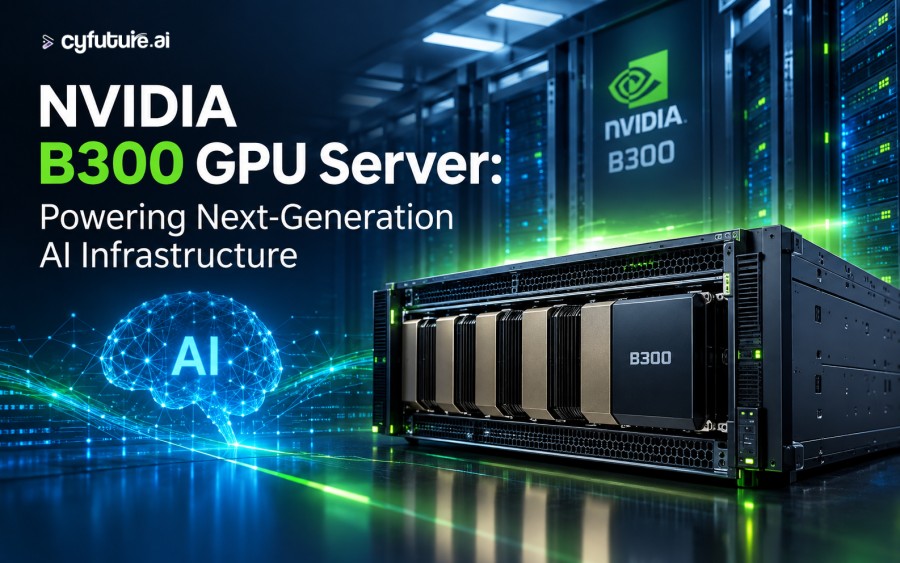
NVIDIA B300 GPU Server: Powering Next-Generation AI Infrastructure
An NVIDIA B300 GPU server is an enterprise computing platform built around NVIDIA Blackwell Ultra GPUs. Depending on the system design, B300 technology can be deployed through platforms such as NVIDIA HGX B300 and NVIDIA DGX B300.
Artificial intelligence is moving from conventional model training toward increasingly demanding workloads such as large language models, generative AI, AI reasoning, agentic systems, and high-throughput inference. These applications require more than raw GPU compute—they need large amounts of high-bandwidth memory, fast GPU-to-GPU communication, high-speed networking, and infrastructure designed to scale.
The NVIDIA B300 GPU, based on the Blackwell Ultra architecture, is designed for this next generation of AI infrastructure. NVIDIA’s HGX B300 platform combines eight Blackwell Ultra GPUs with fifth-generation NVLink and up to 2.1 TB of aggregate GPU memory, creating a high-performance foundation for enterprise AI workloads.
What Is an NVIDIA B300 GPU Server?
An NVIDIA B300 GPU server is an enterprise computing platform built around NVIDIA Blackwell Ultra GPUs. Depending on the system design, B300 technology can be deployed through platforms such as NVIDIA HGX B300 and NVIDIA DGX B300.
NVIDIA DGX B300, for example, contains 8 NVIDIA Blackwell Ultra SXM GPUs, 2.1 TB of total GPU memory, fifth-generation NVLink, and high-speed ConnectX-8 networking. NVIDIA lists up to 144 PFLOPS FP4 Tensor Core performance in sparse operation and 72 PFLOPS FP8 Tensor Core performance for the system.
This architecture is intended for demanding workloads including:
- Large language model training
- AI inference
- Generative AI
- AI reasoning
- Fine-tuning
- Deep learning
- High-performance computing
- Data analytics
- Enterprise AI applications
Why NVIDIA B300 Matters for Next-Generation AI
AI workloads are becoming increasingly compute-intensive. Modern models often contain billions or even trillions of parameters and can require substantial memory and communication bandwidth.
The B300 platform addresses these requirements through improvements across compute, memory, and interconnect technologies.
According to NVIDIA's Blackwell Ultra datasheet, an individual B300 GPU provides 270 GB of HBM3E memory with up to 7.7 TB/s memory bandwidth. The GPU also supports fifth-generation NVLink and PCIe Gen6 connectivity.
For organizations running large AI workloads, these capabilities can help create infrastructure capable of processing larger models and supporting higher-throughput workloads.
High-Performance AI Compute
One of the key characteristics of the B300 platform is its focus on AI reasoning and accelerated computing.
NVIDIA reports that HGX B300 provides up to 144 PFLOPS of FP4 Tensor Core performance in sparse operation and 72 PFLOPS of FP8/FP6 Tensor Core performance. The platform combines eight Blackwell Ultra GPUs, providing up to 2.1 TB of aggregate GPU memory.
This makes B300-based infrastructure relevant for workloads where model size, inference throughput, and computational intensity are major considerations.
AI Training and Fine-Tuning
Training and fine-tuning large models can require substantial GPU resources. Multiple B300 GPUs can operate as a tightly connected compute environment using fifth-generation NVLink.
NVIDIA's enterprise reference architecture describes HGX B300 as an infrastructure platform for AI training, fine-tuning, and inference, with eight Blackwell Ultra GPUs connected through NVLink and NVSwitch technology.
This type of architecture can be useful for organizations developing:
- Large language models
- Multimodal AI systems
- Generative AI models
- Recommendation systems
- Computer vision models
- Enterprise AI assistants
Accelerating AI Inference and Reasoning
AI inference is becoming increasingly important as organizations move models from development into production.
Modern AI systems may need to handle thousands of simultaneous requests while maintaining responsiveness. AI reasoning workloads can also require additional computation compared with traditional inference.
NVIDIA positions Blackwell Ultra specifically for AI reasoning and inference, with enhancements to AI compute and attention processing compared with the previous Blackwell generation.
For enterprises, B300 infrastructure can therefore serve as a foundation for production AI applications where throughput and latency are important infrastructure considerations.
Large HBM3E Memory Capacity
Memory capacity is an important consideration when selecting infrastructure for large AI models.
An individual B300 GPU provides 270 GB of HBM3E memory, while an HGX B300 system can provide approximately 2.1 TB of aggregate GPU memory across eight GPUs. NVIDIA specifies up to 7.7 TB/s memory bandwidth per GPU.
Large, high-bandwidth GPU memory can help AI workloads process large datasets and models without relying as heavily on slower system-level memory.
This is particularly relevant for:
- Large-model inference
- Model fine-tuning
- Generative AI
- AI agents
- Scientific computing
- Large-scale data processing
Fifth-Generation NVIDIA NVLink
GPU communication becomes increasingly important when workloads are distributed across multiple GPUs.
NVIDIA B300 systems use fifth-generation NVLink, allowing the GPUs within supported platforms to communicate at very high bandwidth. NVIDIA lists up to 1.8 TB/s GPU-to-GPU bandwidth and 14.4 TB/s total NVLink bandwidth for the HGX B300 platform.
Fast GPU interconnects can reduce communication bottlenecks in distributed AI workloads and help multiple GPUs operate as a closely connected computing environment.
High-Speed Networking for AI Clusters
Large AI deployments require more than powerful GPUs. Networking infrastructure also plays a major role.
NVIDIA's HGX B300 reference architecture incorporates ConnectX-8 SuperNICs and high-speed networking designed for communication between GPU servers. NVIDIA describes configurations supporting up to 800 Gb/s networking per GPU in its AI factory reference architecture.
This type of networking is particularly relevant when multiple B300 servers are connected into larger AI clusters.
NVIDIA DGX B300 Infrastructure
For organizations looking for an integrated enterprise AI platform, NVIDIA DGX B300 combines B300 GPUs with CPUs, networking, storage, and NVIDIA software.
The DGX B300 configuration includes:
- 8 NVIDIA Blackwell Ultra GPUs
- 2.1 TB total GPU memory
- Up to 144 PFLOPS FP4 Tensor Core performance in sparse operation
- 72 PFLOPS FP8 Tensor Core performance
- 14.4 TB/s aggregate NVLink bandwidth
- ConnectX-8 networking
- BlueField-3 DPUs
- NVMe storage
- NVIDIA AI Enterprise software
NVIDIA lists the DGX B300 system at approximately 14 kW power consumption and a 10U rack form factor.
B300 for Large-Scale AI Infrastructure
A single GPU server can be useful for development, testing, and smaller production workloads. However, organizations working with very large models may require multiple GPU servers.
B300-based infrastructure can be scaled into larger AI clusters using high-speed networking and NVIDIA's enterprise reference architectures.
NVIDIA's HGX AI Factory architecture is designed around multi-node configurations for training, fine-tuning, and high-throughput inference.
At an even larger scale, NVIDIA's GB300 NVL72 architecture combines 72 Blackwell Ultra GPUs and 36 Grace CPUs in a rack-scale system, demonstrating how Blackwell Ultra technology can extend from individual GPU servers to large AI infrastructure.
B300 GPU Server Applications
1. Generative AI
B300 servers can provide the compute and memory resources needed for developing and deploying generative AI applications, including text, image, video, and multimodal systems.
2. Large Language Models
LLM training, fine-tuning, and inference can require substantial GPU memory and high-speed communication. Multi-GPU B300 systems are designed to address these infrastructure requirements.
3. AI Reasoning
Reasoning models can require additional inference computation. Blackwell Ultra is specifically designed to support these emerging workloads.
4. Enterprise AI
Businesses can use B300 infrastructure for internal AI assistants, knowledge systems, recommendation engines, document processing, and other enterprise applications.
5. High-Performance Computing
GPU acceleration can also benefit scientific simulations, engineering workloads, computational research, and other HPC applications.
6. AI Development and Fine-Tuning
Development teams can use B300 infrastructure for experimenting with models, fine-tuning foundation models, evaluating AI systems, and preparing applications for production.
B300 GPU Server vs. Traditional GPU Infrastructure
Traditional GPU servers can remain suitable for many workloads, but newer AI applications increasingly place greater demands on:
- GPU memory capacity
- Memory bandwidth
- Tensor performance
- GPU-to-GPU communication
- Network bandwidth
- Power efficiency
- Cluster scalability
B300-based platforms are designed as integrated AI infrastructure rather than simply adding a powerful GPU to a conventional server.
This distinction becomes increasingly important as organizations move from individual AI experiments toward production-scale AI environments.
Choosing an NVIDIA B300 GPU Server
Before deploying B300 infrastructure, organizations should evaluate several factors.
Workload Requirements
Determine whether the workload involves training, inference, fine-tuning, reasoning, simulation, or a combination of applications.
GPU Memory
Large models can require substantial GPU memory. B300's HBM3E capacity can be an important consideration for memory-intensive workloads.
Networking
For multi-server deployments, high-speed networking can significantly influence distributed workload performance.
Power and Cooling
High-performance GPU servers require appropriate power delivery and cooling infrastructure. NVIDIA's DGX B300, for example, has a listed system power consumption of approximately 14 kW.
Software Environment
Compatibility with CUDA, AI frameworks, model-serving platforms, and enterprise AI software should also be considered when designing the infrastructure.
Conclusion
The NVIDIA B300 GPU Server represents a new generation of AI infrastructure built around NVIDIA Blackwell Ultra technology. With large HBM3E memory capacity, high-bandwidth NVLink, advanced Tensor Core capabilities, and high-speed networking, B300-based systems are designed for demanding AI workloads ranging from model training and fine-tuning to inference and AI reasoning.
For organizations building enterprise AI infrastructure, the combination of GPU compute, memory, interconnect, networking, and software is becoming increasingly important. B300 platforms provide a foundation for scaling AI applications from individual workloads to multi-server AI clusters.
As AI models continue to grow in size and complexity, infrastructure such as NVIDIA B300 can play an important role in supporting the next stage of enterprise AI deployment.
Related Articles
View All Business Blog
Build Smart Contracts with 30% Halloween Offer
Smart contracts are becoming an important part of blockchain applications, enabl...
 Business Blog
🕸️ Build Your Blockchain Solution with 30% Halloween Offer
Blockchain technology is creating new opportunities for businesses to build secu...
 Business Blog
How HR Teams Can Improve Employee Engagement in 2026
Employee engagement is essential for building productive and supportive workplac...
0 Comments
Leave a Comment
No comments yet — be the first to share your thoughts!